Completion Date:
Production Time:
Number Of Discs:
Language(s):
Subtitle(s):
June 15, 2026
6 Weeks
8
English
None
Source(s):
Retail PAL VHS Tapes
Bootleg NTSC & PAL VHS Tapes
Bootleg NTSC DVDs
35mm Film Reels
YouTube Clips
█
Double sided Blu-ray cover artwork - 14mm spine (click to enlarge)
I first saw Dawn Of The Dead on VHS around 1993; the censored 4Front gold cover VHS. In 1997, BBC2 showed the almost-uncut Directors Cut; preceded by an interview with George. This version was over 21mins longer than the VHS release, plus had a lot of the previously-censored violence & gore intact. It was such a big deal to me at the time.
I finally tracked down an uncut version in 2001; the Dutch Filmworks DVD, from The Cinema Store in central London. Having been a regular most weekends for a good few months, the guy asked if I wanted to have a look through 'the horror box', whereby out popped a box from under the counter filled with extreme uncut import DVDs. Over the course of a few months I bought titles such as I Spit On Your Grave, Cannibal Holocaust, Cannibal Ferox, Men Behind The Sun, Naked Blood, Dr Lamb, Organ and Evil Dead Trap, all stupidly priced (£30 - £40 as I recall). Something untoward must have happened, as I went in one weekend and suddenly the guy "had no idea what the horror box was", and that was the end of that!
This is one of a number of standalone Blu-Ray sets, drawing from the huge quantity of source material built up during my 35mm Movie Scans Blu-Ray Box-Set project. This involved renting and buying theatrical prints, trailers & cinema snipes from collectors, and getting them scanned. The Scanner uses professional equipment to scan each frame on each reel to a 4K/5K digital image, and each reels' optical audio strip to a digital sound file. I grade and encode this transfer to give a 1080p 24fps digital recreation of each source print.
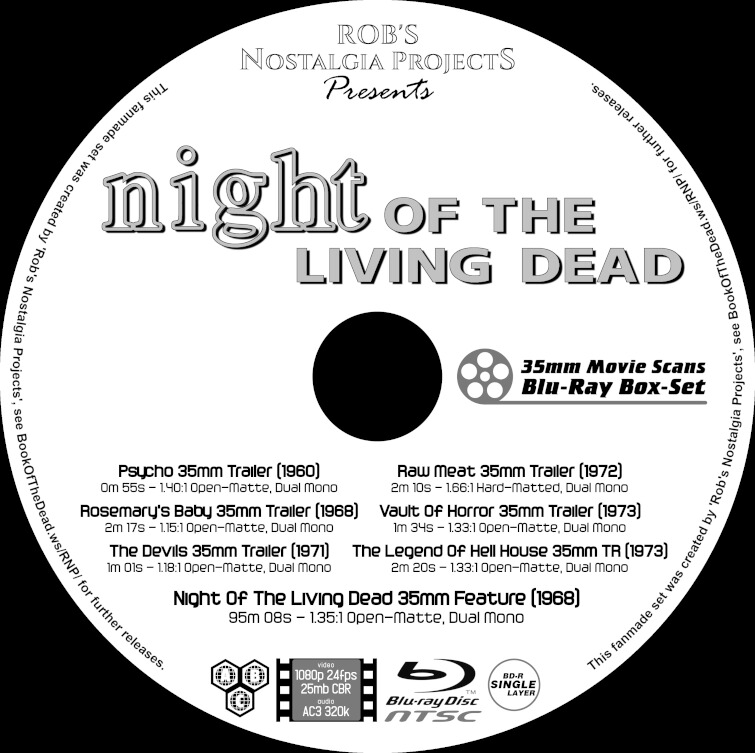
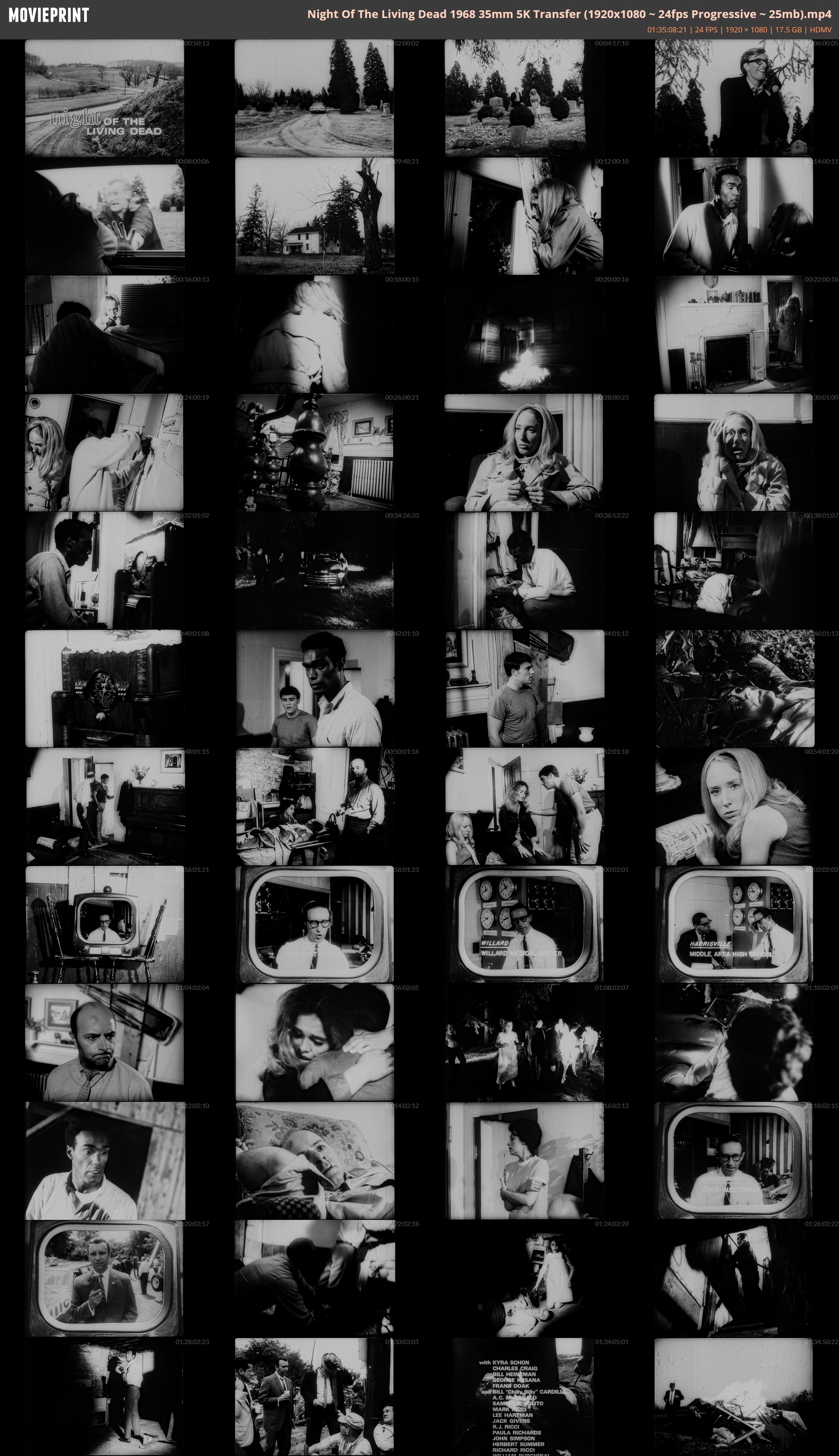
Night Of The Living Dead (1968) - US 35mm 5K Scan
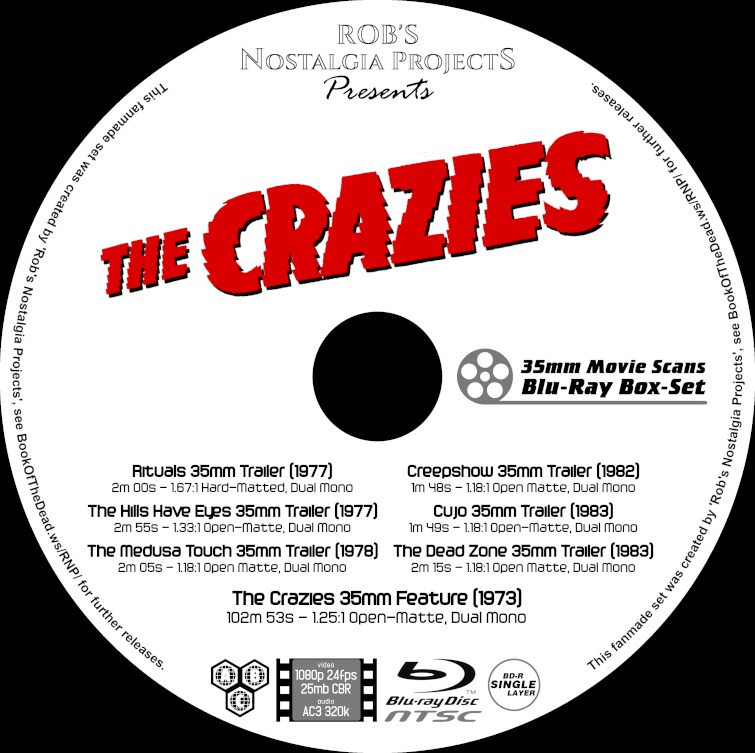
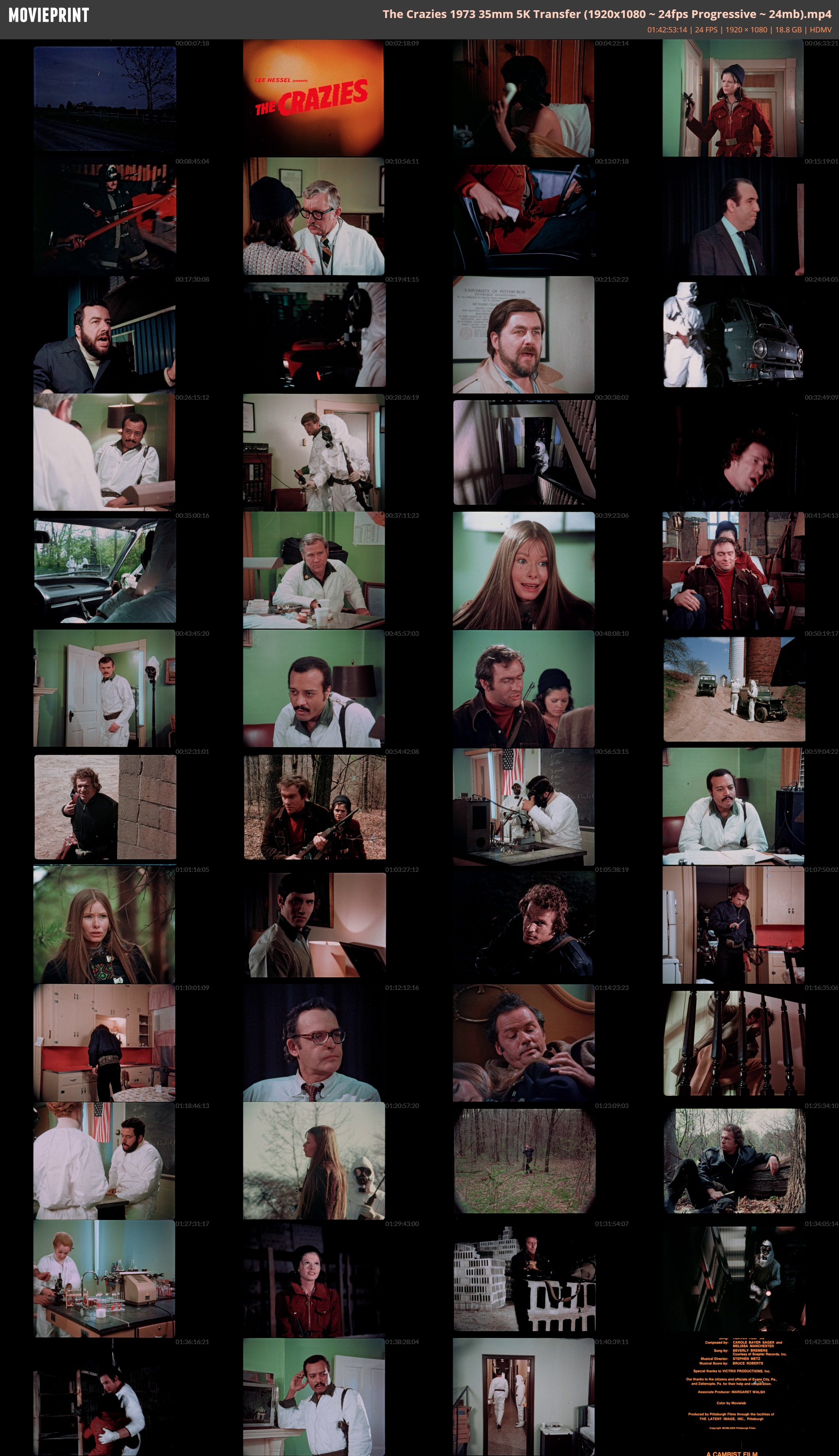
The Crazies (1973) - US 35mm 5K Scan
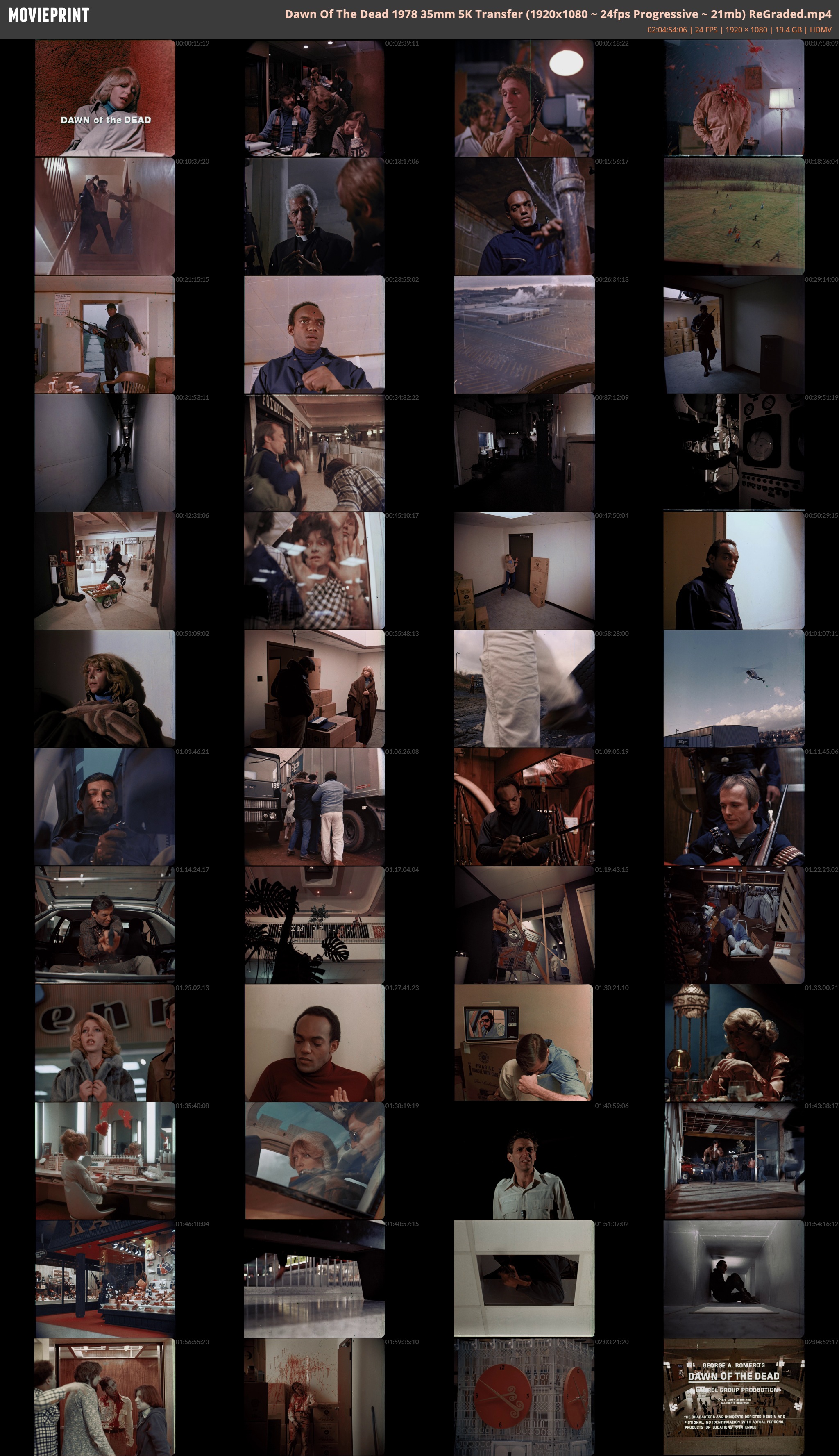
DOTD - Theatrical Cut (1978) - US 35mm 5K Scan
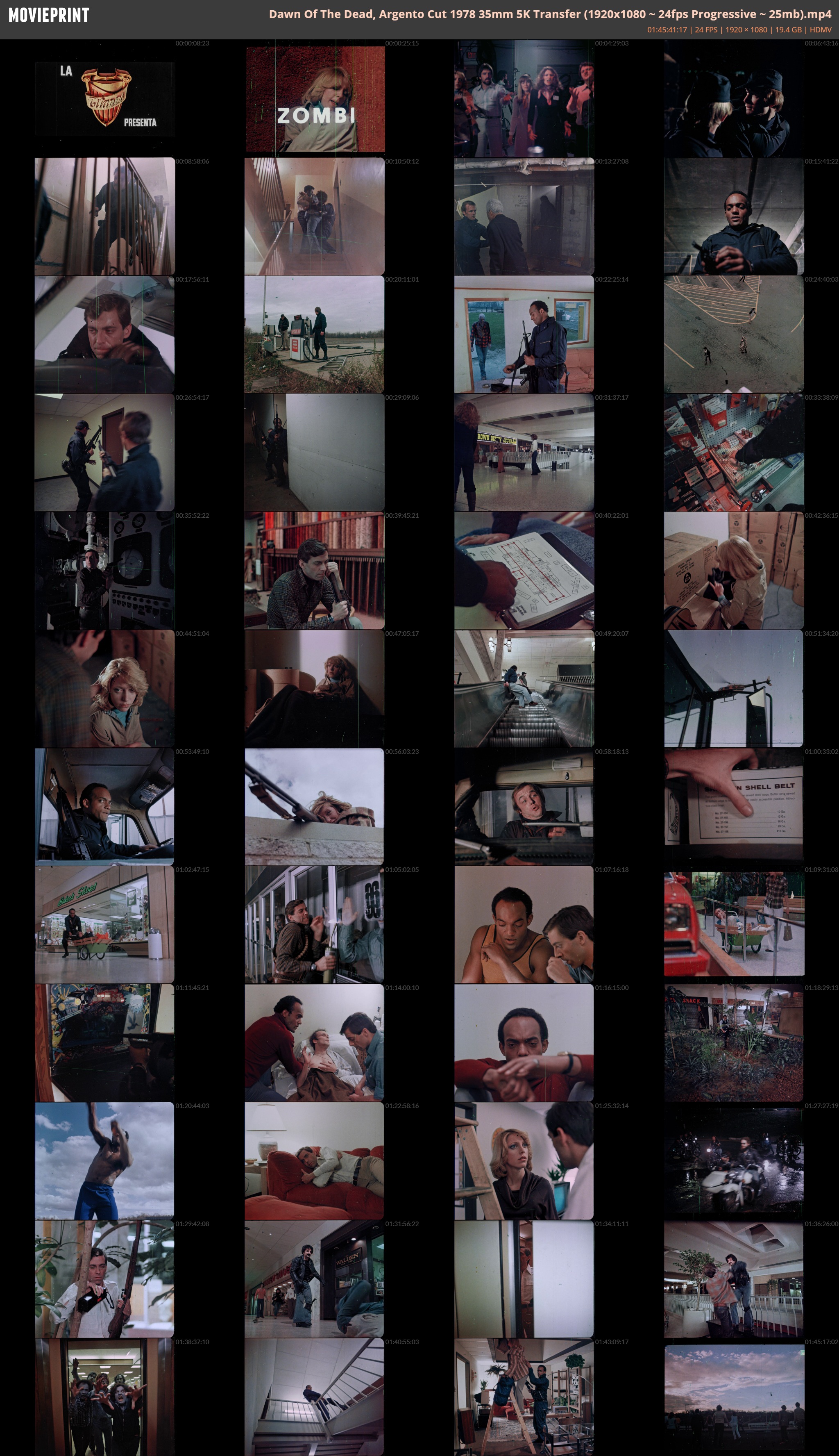
DOTD - Argento Cut (1978) - Italian 35mm 5K Scan
DOTD Ext/Cannes Cut (1978) - US 16mm 5K Scan
Day Of The Dead (1985) - US 35mm 5K Scan
Why watch a 35mm scan over a retail Blu-Ray version? The biggest draw for me is the overall experience of seeing a warts & all 35mm print, over a impeccably perfect and overly sanitised restored digital version. In addition, there is usually a wider un-cropped picture, no modern colour correction, and the original mono or stereo audio mixes. A genuine theatrical experience.
Print scanning is an expensive & time consuming business. It costs a minimum of $600/£510, ranging past $1000+/£840+ per feature depending on length, and around $45/£38 per trailer, to rent & scan in 4K or 5K resolution, and even that is fans' mates rates. The quality of the print, or popularity of the film doesn't come in to it. It costs the same to scan a big Hollywood film as it does an obscure title which few would be interested in, and the same to scan a pristine print as an unwatchable degraded one. As there is a lot of information, this write-up has been split into sections, and you can click to expand each one.
Restored presentation & retail Blu-Ray comparisons
Night Of The Living Dead was scanned in 5K from a US uncut 35mm print. The raw print scan looked quite decent, just being a little dark with micro-scratches in places. This print was struck for the films' re-issue in 1978, paired with the US theatrical release of Dawn Of The Dead.
There was a total of 1m 48s missing over the retail Blu-Ray. That's made up of 45 splices across the print (most with the loss of 2-3 frames each), then a few seconds here in a couple of bigger splices, as well as bits either side of the reel changes, but the biggest section started at 62m 55s with 1m 10s missing. This covers Ben & Harry inside the house talking about the escape plan; which doors to cover and such. I used the UK Blu-Ray to replace the missing section, as it's a better match to the existing footage, and cropped a little wider than the US Blu-Ray. I tweaked the levels, added grain and light scratches to blend it into the existing footage, and it looks pretty seamless.
Night Of The Living Dead (1968) 35mm 5K scan, restoration Resolve/Premiere timelines, & regraded/raw reels
I have cropped my transfer to a 1.35:1 aspect ratio. Most of the print was hard matted to 1.35:1, although the matting does vary slightly shot to shot, so I've cropped to the widest-matted shots. There are also a number of full 1.18:1 open-matte single shots and sequences. I thought switching back & fourth from 1.18:1 to 1:35:1 to try and preserve every open matte shot, would be quite jarring for the viewer. In the end I decided to let the closing sequence play as 1.18:1 open matte, and crop the remainder to 1.35:1. It's unclear if a complete open matte version would actually exist, or if the differing aspect ratios would be as a result of different cameras, film stock, or some other technical element.
You can see more picture on every side over the 1.33:1 cropped retail US Blu-Ray release. In comparison, the Blu-Ray looks quite different throughout. Overall it's brighter, with far lower contrast making the blacks & whites all appear shades of grey. The 35mm print probably goes too far the other way, with heavier black shadows and brighter highlights, but this is what you would have seen in theatres, so it is what it is. The audio here is mono, presented here as dual mono, taken from the 35mm optical strip.
This feature is presented as a pretend UK projection, with UK 70s Classic Cinemas snipes, adverts, and 35mm trailer scans for Psycho (1960), Rosemary's Baby (1968), The Devils (1971), Raw Meat (1972), Vault Of Horror (1973), & The Legend Of Hell House (1973), all in 4/5K.
Restored presentation & retail Blu-Ray comparisons
The Crazies was scanned in 5K from an American uncut open-matte 35mm print. The raw print scan looked quite decent, just being a little dark & faded slightly to purple. Other than that, the print was in excellent condition.
The print varies between two aspect ratios from shot to shot; the full frame at 1.18:1, and a tighter ratio of 1.50:1, likely due to differing cameras or film stock. The retail Blu-Ray is cropped tighter still at 1.66:1. In either ratio, you can still see more picture top & bottom over the cropped retail Blu-Ray release. In comparison, the finished restoration looks fairly similar to the Blu-Ray release in terms of colours & levels, although there are variations in places and the blues have been pushed more here & there on the retail Blu-Ray, as well as seeming overly saturated at times. The audio here is dual mono, taken from the 35mm optical strip.
This feature is presented as a pretend UK projection, with UK ABC Cinemas 'Red-Silk' 70's snipes, adverts, and 35mm trailer scans for Rituals (1977), The Hills Have Eyes (1977), The Medusa Touch (1978), Creepshow (1982), Cujo (1983), & The Dead Zone (1983), all in 4/5K.
Restored presentation & retail Blu-Ray comparisons
Dawn Of The Dead - Theatrical Cut was scanned in 5K from an American uncut open-matte 35mm print. For a 70s vintage print, it was in surprisingly decent shape, although it did have significant red-fade, and there were also variations in levels, exposure, saturation & colour balance, from section to section, and even shot-to-shot in some places. Given the low budget production & various cameras and film stock used, this would have been present on the original print for the most part, but I've toned much of it down.
My first restoration of this 35mm print scan was released with the original February '23 set (although it was scanned back in September '22, and graded in December '22). This is the second revised version, completed a year later in January '24. I decided to have another go as this for a number of reasons, but mainly that it was certainly my worst attempt at regrading in all the releases so far. This was due to it being only my second Resolve processed print, my first really-red-faded print, it was regraded on an uncalibrated monitor, and test-watched on a cheap digital projector (plus in terms of levels & colours, it's quite an uneven movie anyway). I thought I could make a much better job second time round, and produce something I'd be happy to watch myself as a big fan of the feature.
The January '24 Argento version was virtually a shot-by-shot regrade; hugely intensive and time consuming, and took nearly a month of solid work. Knowing even more time & work would be involved in this longer & more-faded Theatrical cut, I wasn't keen on investing that much time over again, with a queue of newer 35mm scan regrades still waiting. I thought a really decent Resolve reel by reel correction, with some whole-scenes and odd shots tweaked, while not a full regrade, would still be a big step up from the original encode, and would take less than a week. Aside from the revised colours & levels, it's frame for frame identical to the old version.
Dawn Of The Dead (1978) 35mm 5K scan, restoration Resolve/Premiere timelines, & regraded/raw reels
It has an open-matte 1.18:1 aspect ratio. The retail Blu-Ray was scanned from the camera negative so that frame is slightly wider than this 35mm, but looses a fair bit top & bottom once cropped to 1:85:1. The Blu-Ray also goes very heavy on the colour saturation. The 35mm scan quite closely matched the more-natural-looking 1981 UK Intervision pre-cert VHS. The audio here is dual mono, taken from the 35mm optical strip.
Via the same avenue, will also be getting scan of the 16mm version of the Dawn Of The Dead Extended Cut, which will form a future addition to this project. It would seem that this version never originally existed as a working 35mm cinema print, as it was never theatrically released, save a 16mm showing at Cannes in 1978. That said; 16mm quality-wise is around 1/4 the frame size of 35mm, which is roughly the same difference in resolution as full-screen Blu-Ray to DVD. Further, DVDs are still usually mastered from 35mm elements, so a 16mm scan will tend to be softer than DVD, more akin to good quality Laserdisc. Lastly (maybe not this print, but in general), 16mm prints were usually intended for home projection, so they tended to be cheaply duplicated in comparison to proper theatrical 35mm prints.
The 'Extended/Director's cuts' of most features only usually exist on home-media, unless they have been given a proper 35mm cinema re-release in the last 30-ish years; Blade Runner: Final Cut, The Exorcist: Director's Cut & Apocalypse Now Redux are a few high profile 35mm re-release examples. Whereas the Aliens Extended cut, and Robocop unrated/uncut only ever existed on home-media. Production houses releasing official media can of course access original 16/35mm elements for scanning. I of course cannot.
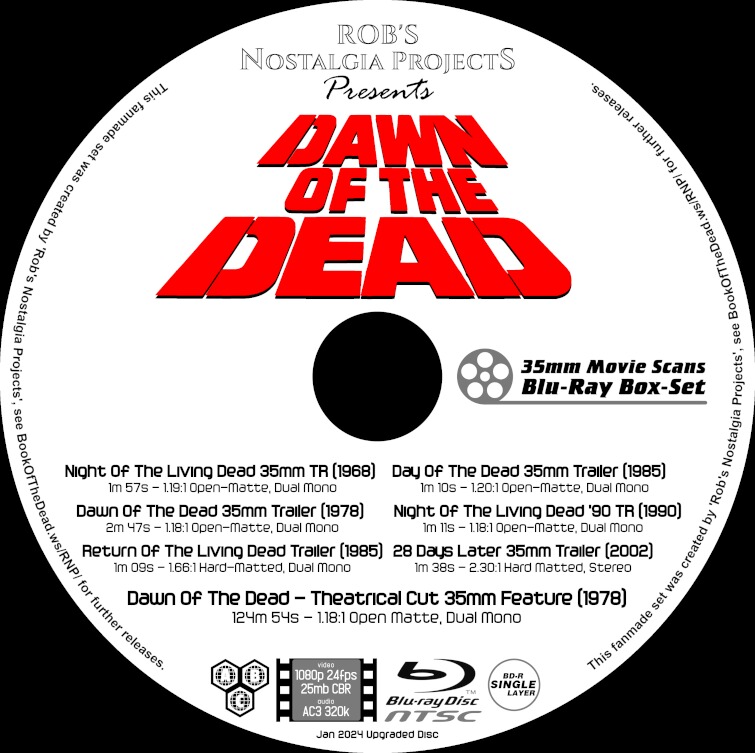
This feature is presented as a pretend UK projection, with UK Late 70's Odeon Cinemas 'This Is Cinema' snipes, adverts, and 35mm trailer scans for Night Of The Living Dead (1968), Dawn Of The Dead (1978), Return Of The Living Dead (1985), Day Of The Dead (1985), Night Of The Living Dead (1990), & 28 Days Later (2002), all in 4/5K.
Restored presentation & retail Blu-Ray comparisons
Zombi: Dawn Of The Dead (the European/Argento cut) was scanned in 5K from an Italian uncut open-matte 35mm print. It's worth saying first, that this isn't an ideal print for preservation, but it is the only one available, so it's this or nothing. Quality-wise, this print is decent enough in comparison with the other prints I've scanned; a bit scratchy at both ends of each reel, which settles down after a minute or two. The issue is the number of splice/repairs resulting in missing footage. A few are expected with even the best quality prints, along with a few seconds missing at reel changes. This film should run 117m 25s (not including the end credits; covered later), my scan runs 105m 24s. That leaves 12m 08s of footage missing from the 35mm source print. That's an awful lot, more even than the original 1960s Psycho print scan further up.
R1 looses 2m 20s over 37 splices & heads/tails
R2 looses 1m 25s over 26 splices & heads/tails
R3 looses 2m 08s over 28 splices & heads/tails
R4 looses 2m 47s over 37 splices & heads/tails
R5 looses 2m 07s over 38 splices & heads/tails
R6 looses 1m 21s over 29 splices & heads/tails (excluding end credits)
TOTAL 12m 08s lost, over 195 splices, heads/tails
It's not a censored print, all the gore is there, and it's not a different edit. This is frame-for-frame identical to the standard Argento cut; just missing bits. What makes it trickier to fix is that the missing footage is made up of little sections spread though-out the print. Between my previous Dawn Of The Dead: Theatrical Cut 35mm scan, and the Italian open-matte Blu-Ray release, and a boatload of work, could I fashion together a roughly complete presentation? Probably yes, roughly, but I feel that's somewhat missing the point of this overall project, so I've just decided to let the print play as-is.
While many other more serious 35mm scanners, such as the number of high profile Star Wars projects for example, might take weeks, even months or years painstakingly reconstructing a 100% complete & faithful theatrical representation, my presentations are more of a bit of fun. Virtually everyone watching this will have seen it many times before, you know the lines, you know what's coming next, so if you wanted a frame-complete polished restoration with accurate colours, levels, cropping, you'd already be watching one of the retail Blu-Rays. This is a working 35mm print, and it's what you might have seen if you'd gone to a little grindhouse Italian cinema in years past. With all the above in mind, either you'll find it a fun experience, or it's not for you, it just is what it is.
Zombi: Dawn Of The Dead (1978) 35mm 5K scan, restoration Resolve/Premiere timelines, & regraded/raw reels
The end credits are another tricky bit. The 35mm print's opening credits are in Italian, but the final reel just ends on the final shot of the Helicopter flying away, without any end credits, cutting off the Gobin music. Every retail release after 2001, has newly created English credits. Before that you had credits in a different format. The 2000 Dutch Filmworks DVD, and the 1995 Japanese Bandai/Emotion Laserdisc; identical to each other, but again in English. It's likely to assume that an Italian film, dubbed into Italian, with Italian opening credits, would similarly have Italian closing credits. For the whole of the end credits to be gone, not even a small section left, makes me think maybe there weren't any originally. I haven't been able to confirm anything either way, and the ending is rather jarring. As a compromise, I decided to extend the last reel using matching black 35mm scanned footage, shorten/edit the rest of the Gobin track down, and play it to its conclusion.
Ironically, this 35mm print was less faded, with better colours than my previous Theatrical cut 35mm scan, so actually looks better colour-wise. Further, the Theatrical cut was my very first faded 35mm scan back in December 2022; restored using an uncalibrated monitor, plus my regrading skills have come on a bit since then. The grading took around fifteen days of solid work, far more than normal. A huge number of shots were individually graded, as you can see from the very busy Premiere timeline screenshot above.
In comparison to the retail Blu-Ray, they match for the most part, although the Blu-Ray is darker in places, with some odd grading choices. The Blu-Ray roughly crops off the top & bottom of the 35mm, to give a 1.85:1 aspect ratio. There are a fair number of shots however, which are wider than my print, then zoomed in tighter than my frame, then up the frame, and down, wider framed off to the left or right. It seems logical that during the Blu-Ray restoration, you might mix and match identical shots from different versions to cover up damage and save restoration time, which might account for the mismatch. That's just a guess though.
The print's Italian language audio was replaced with the retail US Blu-Ray's 2.0 English stereo audio, with levels adjusted to more match the original stereo optical track. I also added a little static noise across the whole audio, as well as heavier static & 'pops' at reel changes to make the A/V a better match.
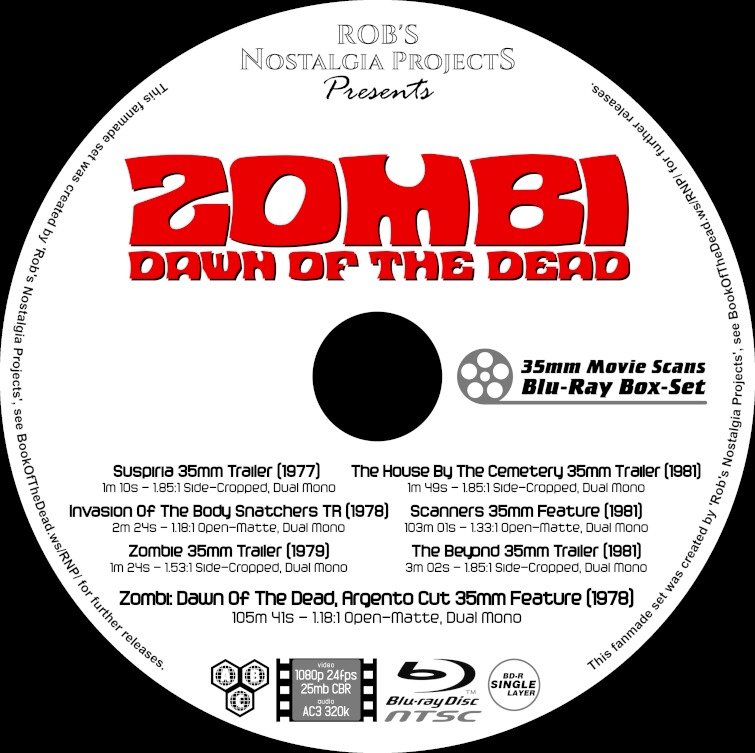
This feature is presented as a pretend UK projection, with UK 70's ABC Cinemas 'Neon' snipes, adverts, and 35mm trailer scans for Suspiria (1977), Invasion Of The Body Snatchers (1978), Zombie (1979), The House By The Cemetery (1981), Scanners (1981), & The Beyond (1981), all in 4/5K.
Restored presentation & retail Blu-Ray comparisons
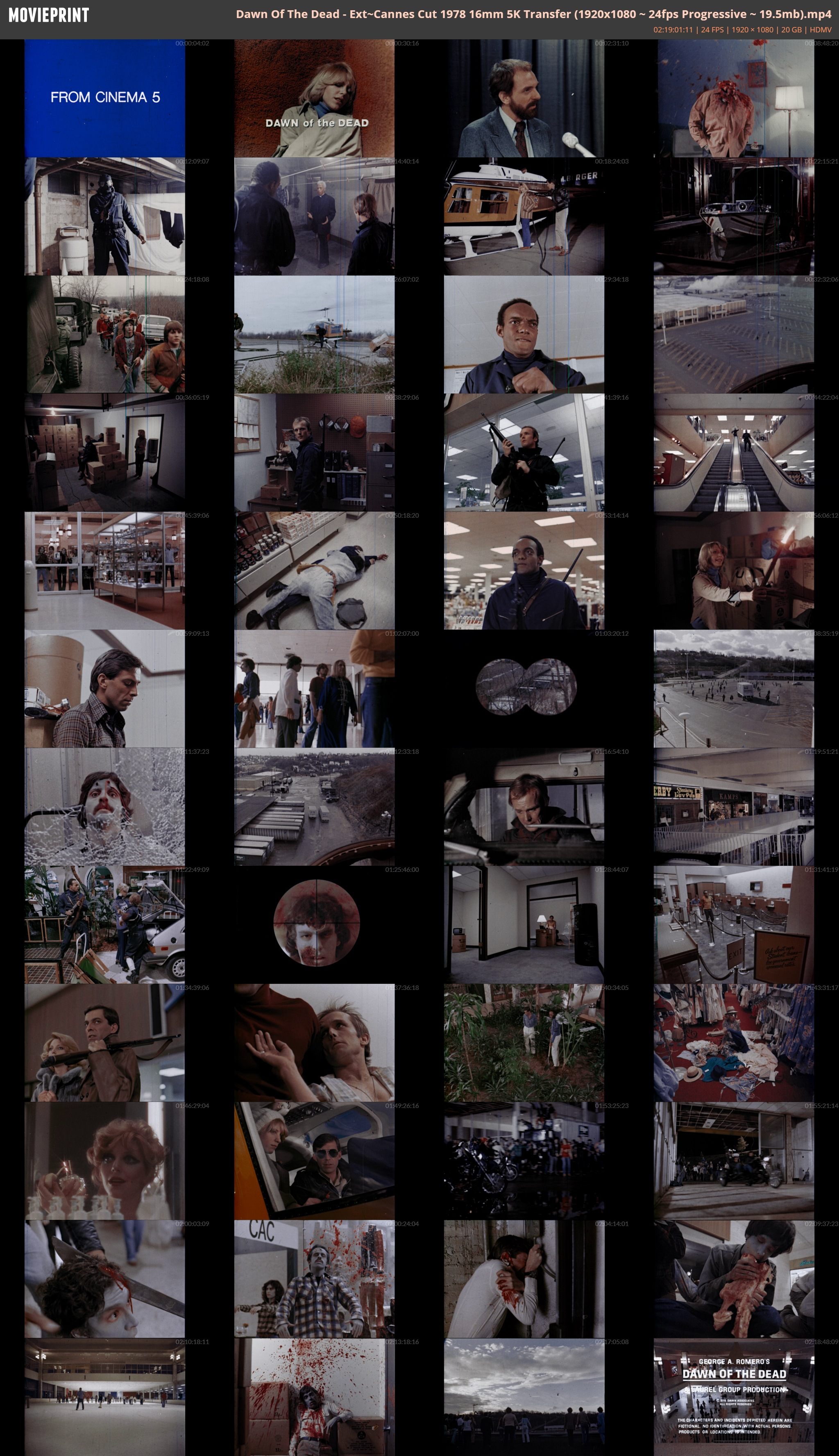
Dawn Of The Dead - Extended/Cannes Cut was scanned in 5K from an American uncut open-matte 16mm print. The print was quite red-faded, but for the most part in fair condition. Reel 1-2 has some heavy scratches on the right of frame starting at around 3m up to the end of that reel at 38m. The remaining reels look better with some light scratches here and there. It's not as sharp as the Duel scan, but it's still fine enough for 16mm, especially as no 35mm print is available of this version. In comparison to the retail Blu-Ray, the 16mm source print is nearly complete, loosing only 27s 18fr over 26 splices including each of the six reels' heads & tails. 14 of those splices are in the first 3mins, so it settles after that.
As a general rule, I would always opt for a 35mm scan over the same in 16mm. There are three main reasons. 16mm film is just under one-quarter the size/resolution of 35mm; 16mm at (10mm x 7.5mm) vs 35mm at (22mm x 16mm), both at 1.37:1. That's very roughly analogous to DVD vs Blu-Ray resolution. Secondly given the smaller size, any defects such as scratches/dust, will be far more magnified in that smaller size. Lastly, 16mm was generally seen as a cheaper home-theatre-format. This meant that not only that much of the duplication was done on the cheap (and the quality would suffer as a result), but also less care tended to be taken over the life of the print, in comparison to more valuable 35mm theatrical prints.
The above aside, you occasionally get material such as the TV version of Duel, along with this feature version, which are simply not available on 35mm, and when well cared for can make excellent scanning source material.
Dawn Of The Dead - Ext/Cannes Cut (1978) 16mm 5K scan, restoration Resolve/Premiere timelines, & regraded/raw reels
Originally this would have come on six reels, but this print was spliced together on to three larger reels for ease of projection. I have tried to check into the providence of this print. I'm told that in the 1980's, the 16mm extended version made was available for rental by mail-order for smaller venues and college campuses, which had to then be returned after use. Why this extended version would be distributed as opposed to the standard theatrical version is unclear. For more information see Here and Here.
This grade was done in Resolve, using Premiere only for a couple of final tweaks & encoding. The framing here in comparison to the retail Blu-Ray changes a little from reel to reel. Overall you get more on the right with the Blu-Ray, and sometimes a little on the left, whereas the print shows more frame on the top & bottom.
The 16mm colour restoration took quite a while, as the colours & levels cycle throughout requiring a shot-by-shot correction in places to give an even look. The scan was cut into 696 sections for individual correction. The colours on the retail Blu-Ray are quite different to 16mm print. The Blu-Ray is heavily over saturated, with strong greens & purples, and some odd grading choices. The 16mm print is more muted and even overall. The Blu-Ray is of course sharper with more detail. The audio here is dual mono, taken from the 16mm optical strip.
35mm Theatrical Cut -vs- 16mm framing comparison
35mm Argento Cut -vs- 16mm framing comparison
You can see frames above, comparing both the Theatrical & Argento 35mm prints, to this 16mm Extended print. This 16mm print is very close on the sides, but looses a some top & bottom to crop the frame aspect ratio from 1.18:1 down to 1.36:1.
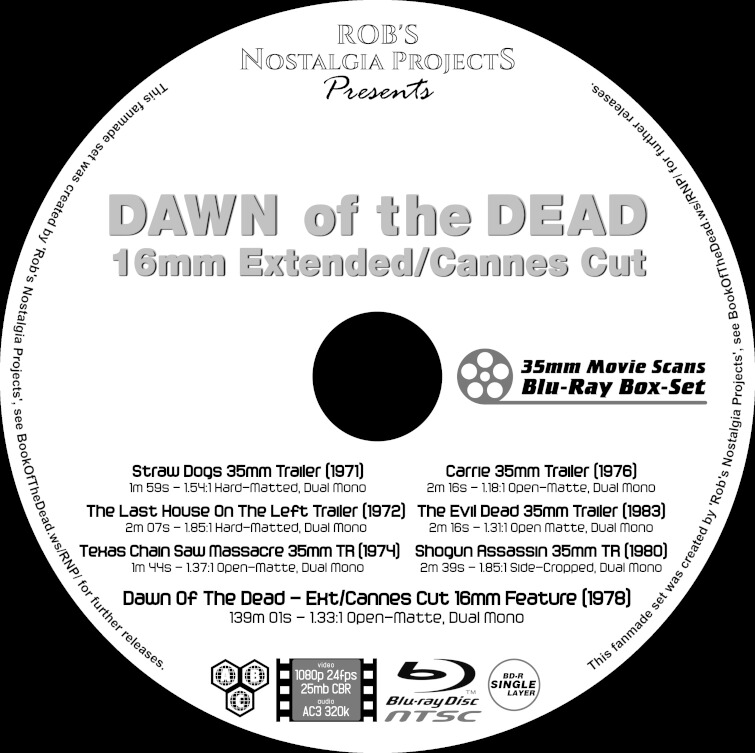
This feature is presented as a pretend UK projection, with US 70's Astro Dater snipes, adverts, and 35mm trailer scans for Straw Dogs (1971), The Last House On The Left (1972), The Texas Chain Saw Massacre (1974 Mock-up), Carrie (1976), The Evil Dead (1983), & Shogun Assassin (1980), all in 4/5K.
Restored presentation & retail Blu-Ray comparisons
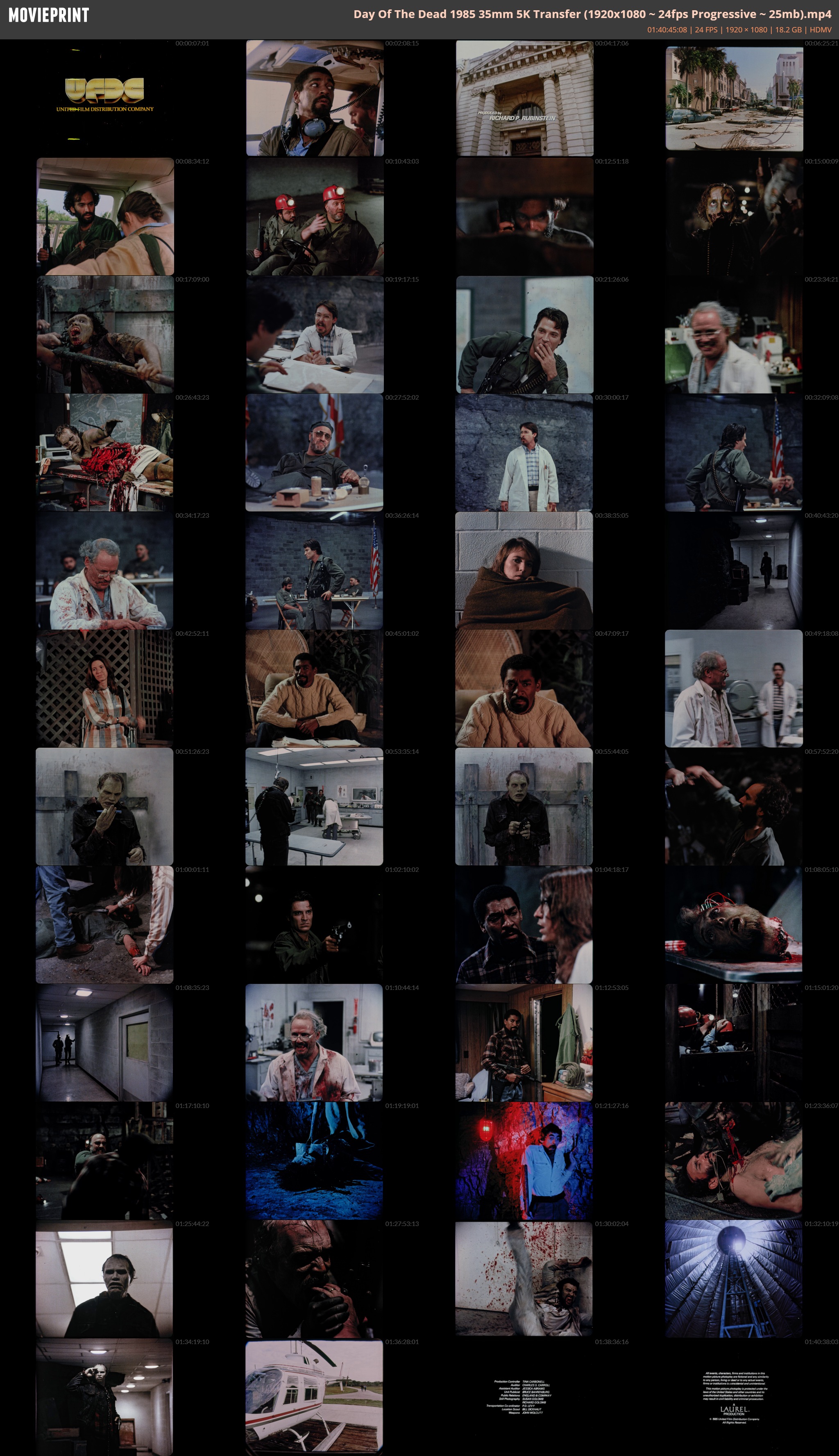
Day Of The Dead was scanned in 5K from an American uncut open-matte 35mm print. Other than being a little red-faded, the print was in excellent condition. There were only five little splices of a few frames each, and twenty seconds missing across the five reels' heads & tails.
All the opening credits shots, along with shots with a super-imposed gun-muzzle-flash, had a tighter white border around the edge. I masked this right up to the very edge of the frame, to leave the full shot visible, without the border.
Day Of The Dead (1985) 35mm 5K scan, restoration Resolve/Premiere timelines, & regraded/raw reels
The framing here is quite a bit wider in comparison to the standard retail Blu-Ray, giving more picture on all sides, especially the top & bottom. The cropping is virtually identical across the Blu-Ray. The 35mm colour restoration was fairly simple as the colours & levels on the whole were very even across each reel, as would be expected for a bigger budget production. As the 35mm print was only a little red-faded, the regraded colours came back nicely. It was a vastly quicker & easier re-grade than Dawn Of The Dead. The audio here is dual mono, taken from the 35mm optical strip.
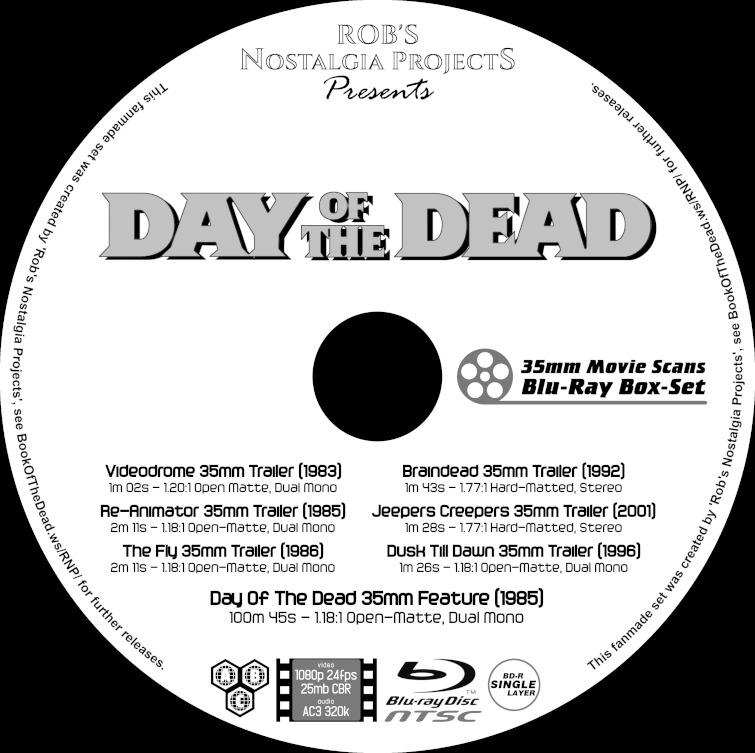
This feature is presented as a pretend UK projection, with UK 80's Odeon Cinemas 'First Choice' V1 snipes, adverts, and 35mm trailer scans for Videodrome (1983), Re-Animator (1985), The Fly (1986), Braindead (1992), Jeepers Creepers (2001), & Dusk Till Dawn (1996), all in 4/5K.
In terms of extras, I wanted to avoid too much repetition with the excellent 2019 fanmade Dawn of the Dead - Ultimate Edition Vol3 Blu-Ray (or the earlier 2006 Vol2 DVD). The three repeated items I have included here, are either an upgrade in quality, running time, or both.
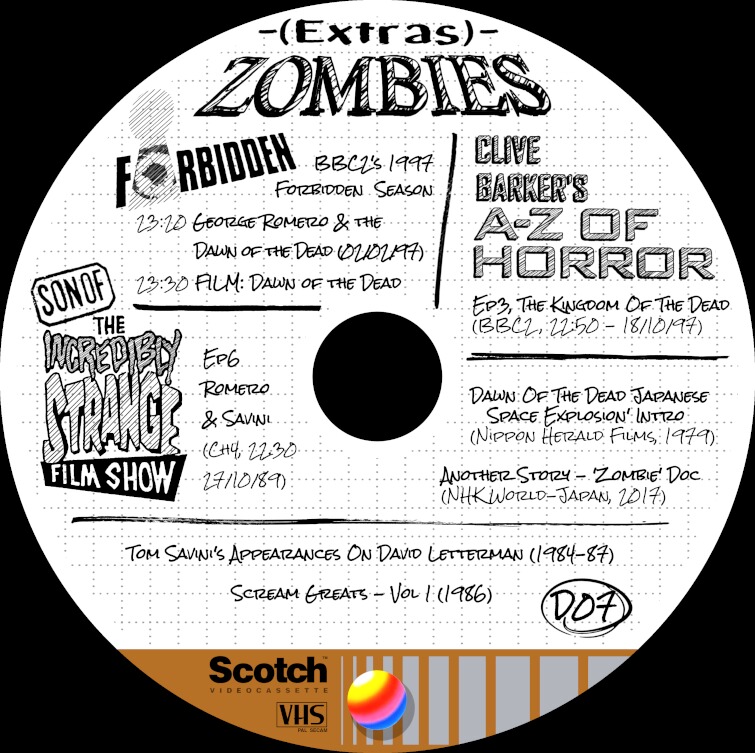
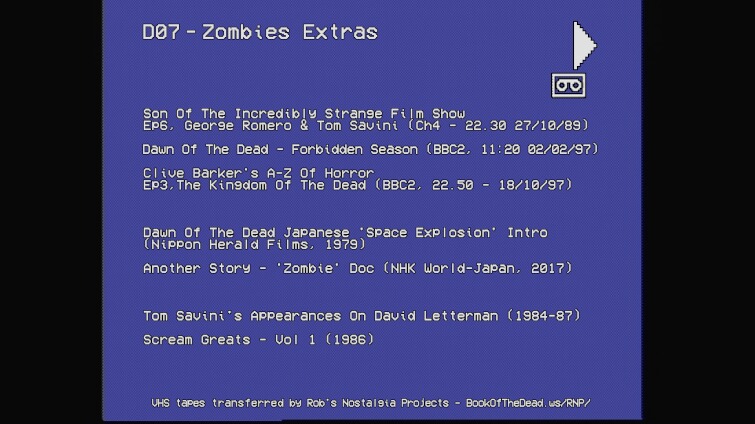
Son Of The Incredibly Strange Film Show Ep6, George A. Romero & Tom Savini (43m 47s - Ch4 - 22.30 27/10/89) This is episode six of the second series showcasting directors, with interviews & clips presented by Johnathan Ross. It covers the early days and Night Of The Living Dead, up to Day Of The Dead, released only a couple of years before.
Dawn Of The Dead The Forbidden Season (150m 35s - BBC2, 11:20 02/02/97) BBC2 ran a Forbidden season over between January to March 1997, showing a number of contentious films, prefaced by short documentaries, often featuring the film-makers themselves. On the 2nd of February 1997, BBC2 showed the UK TV premiere of Dawn Of The Dead, with a 9min documentary playing before called George Romero and The Dawn Of The Dead. This is a full preservation of that airing, shown a few months before the BMG 1997 VHS release of the same. Prior to this you could only see the heavily censored US theatrical cut on VHS. I had assumed this airing would be identical to the Extended Cut BMG VHS release, but it's further censored beyond the 6secs taken out of that BBFC passed VHS. Lost is the machete in the face, and some of the gorier montage sequences at the end of the biker invasion are also edited out.
Clive Barker's A-Z Of Horror Ep3, The Kingdom Of The Dead (44m 13s - BBC2, 22.50 - 18/10/97) This was a British documentary series written and hosted by Clive Barker, exploring the history of horror, from the cinema to art. Each of the segments was also introduced & narrated by Clive. A section of this episode covers the Romero Dead Trilogy, featuring interviews with actors & crew, and clips.
Dawn Of The Dead Japanese 'Space Explosion' Intro (49s - Nippon Herald Films, 1980) This is a newly created replica of the introduction of the 1980 Japanese TV edit of Dawn Of The Dead. It's often referred to as the Suspiria version, as all the music has been replaced with tracks from Goblin's Suspiria score, as well as being dubbed, and trimmed down to 90 minutes. Around 2015, this version was released on Blu-Ray; released as a reward to reward to crowdfunding project contributors in very limited numbers. The sets themselves even second hand sell for huge amounts (The last one I saw was for 55,000YEN / $350), and I never managed to get a copy. This opening was recreated by myself, using a second of a Youtube trailer for that Blu-Ray release.
Another Story - 'Zombie' Doc On NHK World-Japan (60m 00s - 2017) 100% credit to my Japanese friend Keiichi, who recorded this and mailed it to me. Another Story (アナザーストーリーズ 運命の分岐点) is a documentary series broadcast on Japanese public brodcaster NHK WORLD. Each episode explores pivotal moments in modern history through firsthand accounts. This episode presented by Erika Sawajiri, was titled ゾンビ (Zombie), telling the story of Night Of The Living Dead through to Dawn Of The Dead, as well as covering the Resident Evil games and more. It features interviews with George, Tom Savini, John Russo, & Russ Streiner among others, intercut with clips and informational skits. The downside; it's entirely in Japanese, without subtitles.
Tom Savini's Appearances On David Letterman (51m 54s - 1984-87) This compilation covers all five of Tom Savini's appearances on Late Show with David Letterman, from 1984 to 1987; June 13 1984, Oct 3 1984, Feb 13 1985, Aug 20 1986, Apr 28 1987. In each one, he presents & explains various effects, often roping in David. These five entries come from various sources. Three are very decent, with the other two rougher VHS transfers.
Scream Greats - Vol 1 (53m 59s - 1986) A documentary released by Fangoria Magazine, detailing the career of make-up effects artist Tom Savini; interviews intercut with clips from a number of his films, and behind the scenes footage.
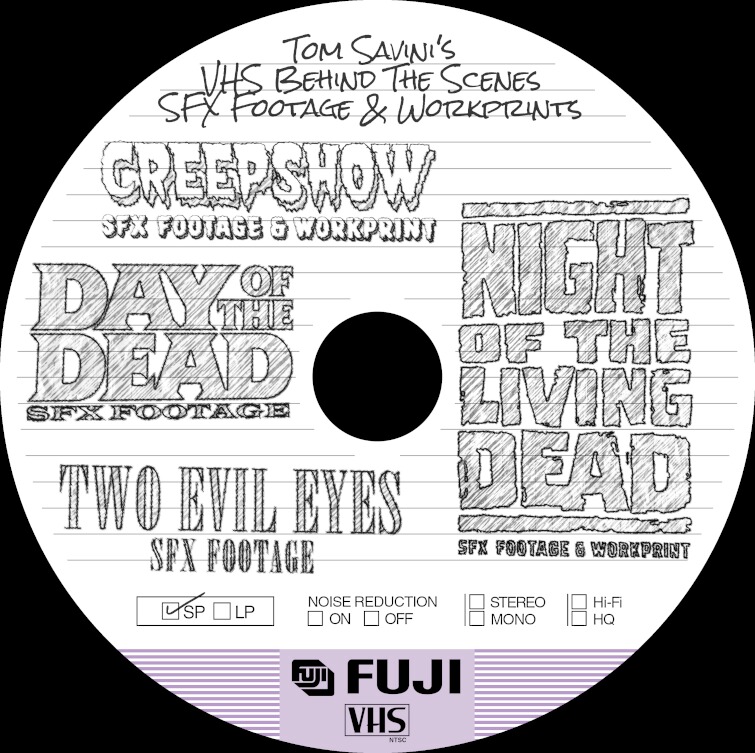
This disc contains some pre-existing bootleg VHS to DVD transfers which I though would have a fitting home here. This included Creepshow, Day Of The Dead, Night Of The Living Dead '90, and Two Evil Eyes; various workprints & behind the scenes effects footage. Just to say up front, none of this was transferred by me, and the quality isn't great. I've had copies these for years and I just authored them all together from the seven source DVD-Rs, to one BD-R disc, with new menus & disc art.
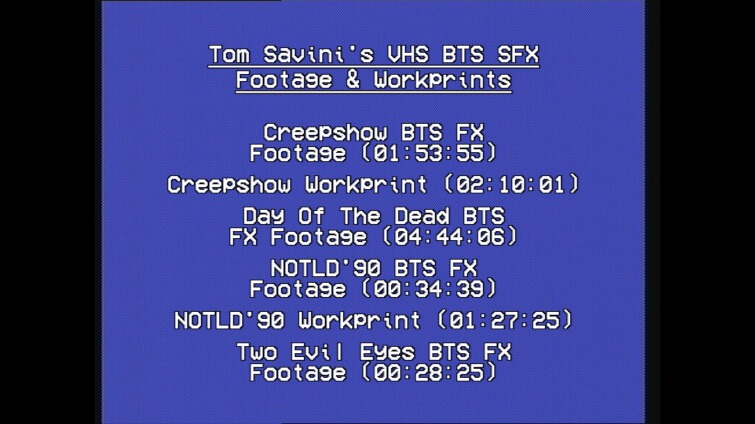
Creepshow Behind The Scenes Effects Footage (1982 - 113m 55s) Bought from US DVD trading website in September 2004. This presents nearly two hours of camcorder footage, with effects tests and filming sequences, many which never made it into the film itself.
Creepshow Workprint (1982 - 130m 01s) Bought from US DVD trading website in September 2004. It's an early workprint running around 10mins longer than the released feature, with additional shots & scenes, and gore which was cut to secure an R-Rating. This incudes Aunt Bedelia's backstory in the 'Father's Day' segment. 'Something To Tide You Over' has more dialogue between Richard & Harry, and 'They're Creeping Up on You!' with extended cockroach effects shots.
Day Of The Dead Behind The Scenes Effects Footage (1985 - 284m 06s) Bought from US DVD trading website in September 2004. This is a huge marathon of camcorder footage covering much of the production. As an aside, back in March 2022, a user called Mark posted on the Facebook timeline, that he owned a number of original VHS tapes containing over seven hours of Day Of The Dead Behind The Scenes Effects Footage originally purchased from a teacher at the Savini School of Make-up. Despite making contact, he wasn't keen on sharing or trading it. So there is at least another 2-3 hours of footage which seems not to have been released in the bootleg community.
Night Of The Living Dead '90 Behind The Scenes Effects Footage (1990 - 34m 39s) Bought from US DVD trading website in September 2008. While fairly short, this camcorder footage covers make-up effects tests, though to on-set filming, with a number of effects censored from the finished feature.
Night Of The Living Dead '90 Workprint (1990 - 87m 25s) Downloaded from a now-defunct website in May 2010. Before the 2025 4K release of this feature, the only version available worldwide was the censored US R-Rated version. That new 4K release somewhat relegates this workprint, but it's an interesting curio non-the-less. I have had a number of versions over the years, this is the highest quality version I own.
Two Evil Eyes Behind The Scenes Effects Footage (1991 - 28m 25s) Bought from US DVD trading website in September 2008. Another somewhat short entry. This camcorder footage starts with prototyping make-up effects and shop tests, progressing to on-set filming.
The artwork was a fairly simple choice; a double sided Blu-Ray cover with a modified version of the Intervision cover on one side, and the Entertainment In Video cover on the other. I'm sure most people will choose the Intervision side, but it's nice to have the choice.
The set is supplied in an Elite 25mm blue 8-way Blu-Ray case, with a laser-printed double sided cover & printed disc artwork. All the discs are region free single layer Verbatim BD-Rs in NTSC format, and everything plays in English language.
In July 2022, I spent a day modifying the previous release of this set's Intervision UK pre-cert VHS trailer, to be included in future DVD/Blu-Ray projects as an an advertisement for this set. The modification just involved overlaying my own text; carefully tweaked to appear identical to the trailers original on-screen text. While this trailer might only get a handful people interested who would not have been otherwise, it's really just a fun side-project. While it was created for the previous release, it works just as well here, although I may update it at some point.
As of writing, this set (along with the previous release of this Blu-Ray) have been sent buyers across the UK, plus to states in the USA (California, Connecticut, Illinois, Indiana, Missouri, Nebraska, Nevada, New Jersey, New York, Texas, Vermont), and around the world; including Australia, Canada, France Greece, Ireland, and Sweden
Yes, each feature is presented like a real cinema showing, with 35mm/16mm theatrical trailer scans, plus cinema snipe & advert scans, playing before the main feature. The trailers will either be for other films available or upcoming, or related films I like.
These are not at all intended to be authentic replicas of each films' original cinema showing. Why? Well even if I was able to source each entry on each original showing (which would be virtually impossible), it's far more entertaining to pair up trailers of similar films, along with the most entertaining snipes & adverts. Invariably, original showings would contain trailers for terrible unrelated films, as well as irritating adverts, so this method bypasses that while still presenting a complete 35mm cinema presentation.
Enter The Dragon (1973) 35mm 4K Trailer
Outland (1980) 35mm 5K Trailer
Sorcerer (1977) 35mm 5K Trailer
A Clockwork Orange (1971) 35mm 4K Trailer
The Exorcist (1973) 35mm 5K Trailer
The Silence Of The Lambs (1990) 35mm 5K Trailer
The volume of trailers available is always far more extensive than the features, and there are a great number of films where the trailer is better than the full movie, so there's a wide range I can choose from. You can see a full list of all the trailer scans I have graded to date below; 282 so far. Around 200 of these are trailers I have rented/bought and have had scanned myself, and the remainder are scans done along-with and by others, included here with their permission. All are either US or UK trailers. Click each entry to view screenshots, and use your left & right keys to scroll through them.
I have also sourced a huge collection of 35mm 'Snipes' scans; little bumpers you'd see in cinemas added before, in-between & after trailers such as "previews of coming attractions" & "our feature presentation". Alongside those, I've also collected a fair number of cinema adverts. These might be identical to TV versions of the day, while others might be cinema only, especially 'Concessions' ads; advertising items available to buy in the foyer.
There were a number of different styles over the years both in the UK and US, but I've always really liked the US 'Astro Daters' 70's versions you might have seen in Grindhouse (2007), although I have an assortment of styles to replicate a (pretend) US or UK theatrical showing. You can see a full list of all the snipe & advert scans I currently have to draw from, below. Click each entry to view screenshots, and use your left & right keys to scroll through them.
Every entry above, has been encoded in an open-matte, and cropped 16-9 versions; for use in scope showings. A number of the above have multiple copies (labelled Transfer Tr01, Tr02, etc..).
It costs somewhere between $700/£590 to $1100/£920 per title depending on length, and around $45/£38 per trailer, and even that is fans' mates rates. That includes the rental, scanning, and hard drive/postage or FTP upload (if available). The quality of the print, or popularity of the film doesn't come in to it. It costs the same to scan a big Hollywood film as it does an obscure title which few would be interested in, and the same to scan a pristine print as an unwatchable degraded one.
The most expensive title to release was The Exorcist (1973), costing $1244/£1032 in rental & scanning; which required the compositing of two prints to make an almost complete version. Next would be Bad Taste (1987) at $1122/£931, which was a print I bought outright in order to scan. Then going on down the list The Man Who Would Be King (1975) $883/£732, The Great Train Robbery (1978) $873/£724, The Shining (1980) $826/£685, Dawn Of The Dead - Ext Cut, 16mm (1978) $810/£672, and Fight Club (1999) $806/£668, which are all either prints I bought, or long films which cost more to scan. Certainly a far cry from taking for five months to only raise 60% of my first scan; The Evil Dead, and contemplating giving up!
Time-wise; from paying the owner for rental (or buying the print), going to the scanner, then the the raw scans either arriving in the mail, or being available for download from the scanner's server, might be anything from 1-12 months depending on how busy people are. As it's all mates-rates, they tend to be slotted in when people have the spare time to do it. Restoration work on each print & assembling the final discs, might be another few weeks each, depending on how much work the scans need. Restoration only involves colour & levels correction. Many prints will have some fade which shifts the whites towards red. Older prints can look very red indeed (the below screenshots give varying examples), but even an immaculate print will need at least some work. I do not remove scratches, dust, splices, minor print damage, odd missing frames and such, as my aim is to give a true 35mm theatrical experience. You can see from the above timeline screenshots, that each print may be chopped in to tens or hundreds of sections, with each bit individually corrected to give an even viewing experience.
The biggest draw for me is the overall experience of seeing a warts & all 35mm print, over a impeccably perfect and overly sanitised restored digital version. In addition, there is sometimes a wider un-cropped picture, no modern colour correction, and the original mono or stereo audio mixes. Seeing a 35mm print projected today is fairly unusual. Even at the UK/London art-house Prince Charles Cinema, you might just as easily be watching a polished-perfect digital projection over a genuine 35mm print.
The majority of 1:85:1 movies actually use the full nearly-square 1.18:1 35mm film frame, but chop off the top & bottom of the picture to give that tighter aspect ratio. This removes around 45% of the original image on a cropped Blu-Ray release. A full frame print is referred to as an 'Open-Matte' or 'Flat' print.
Scope is different; it's generally shorthand for an anamorphic print, which usually denotes a 2.35:1 movie. While a Scope picture still takes up the whole 35mm frame, the picture is stretched and needs anamorphically squashed at 2:1 to give the correct aspect ratio. Here, you'll normally get far less additional image over a retail Blu-Ray version as it's virtually in its correct aspect ratio to begin with.
Below you can see a gallery of 35mm stills, in comparison to the framing/cropping & colour grading of the retail Blu-Ray release transfers. As you can see, the 1.85:1 transfers gain quite a bit top & bottom. the Scope 2.35:1 transfers gain far less. As the retail Blu-Rays are usually created from scans of the original 35mm/16mm camera negative (or equivalent), some of the Blu-Rays can be slightly wider than my 35mm/16mm frame.
There are some drawbacks to 35mm scans, however. As mentioned above; most retail Blu-Ray releases will use a scan of a 35mm/16mm camera negative (or equivalent), rather than a scan of a theatrical 35mm print which is a generation-down copy. This means the black/darker areas have a little more fidelity on a Blu-Ray than on 35mm, and the negative will usually be in much better condition to scan from, as it's not a working projection print. Further, movies shot in 16mm and blown-up to 35mm for theatrical projection, may have a sharper picture on Blu-Ray over 35mm. That said, if you want a perfect viewing experience then you're better off with the retail Blu-Ray.
There are two reasons I didn't do 4K releases. Firstly it's a reasonable assumption that given 4K has four times the resolution of 1080p, you'd be getting a great deal more picture detail. This really isn't the case, the difference between 4K and 1080p in terms of this sort of source material is minimal. It's worth saying up front not to get me wrong, the picture quality is certainly on a par with retail Blu-Rays.
While the majority of these prints were scanned in 5K resolution on a top of the line $150K ScanStation (and most of the remainder on a 4K Cintel), once you add in factors such as the source being a vintage working 35mm print, along with grain, weave, warping, print degradation & fading, and the tiny size of each frame (a 35mm frame is 22x16mm, and 16mm is 10x8mm), there are increasingly diminishing returns as you make the picture bigger than 1080p, regardless of the bitrate.
The Shining (1980) 35mm scan (4K @ 100% vs 1080p zoomed) picture quality comparison
If you take these examples, you can see an actual size section of a frame from a 4K encodes at 80mb/s, alongside the same from a 1080p encode at 20mb/s (zoomed here for comparison). The difference between the two is slight at best. The 4K grain is sharper and more defined, but as far as the detail, there is little difference. Certainly not four times the resolution.
Making 4K releases would also have required considerable investment in my setup; I'd need to have replaced all my Blu-Ray drives to be able write UHD discs. The BD-XL 100GB printable discs themselves would be in the region of 20x the price of 25GB BD-R discs, they would take longer to duplicate, fewer people would be able to play these over standard Blu-Ray discs, and more people would likely have playback issues.
Depending on the resolution of the equipment each scanner has; A 5K raw open-matte 4:3 35mm scan once cropped would still be larger than a 4K UHD resolution (3840 x 2160), but a 4K scan would end up slightly smaller when cropped, which would require a little upscaling and isn't ideal. Further, a Scope 2.35:1 scan in 4k would end up around 70% smaller than UHD.
5K open-matte 1.18:1 raw scan is 5120 x 3840, and would be cropped to around 3800 x 3200
5K Scope 2.35:1 raw scan is 5120 x 3840, and would be squashed/cropped to around 3800 x 1600
4K open-matte 1.18:1 raw scan is 3208 x 2200, and would be cropped to around 2400 x 2050
4K Scope 2.35:1 raw scan is 3208 x 2200, and would be squashed/cropped to around 2400 x 1025
Once you combine the above; the slight quality difference, a more limited audience, and the practical & financial issues of making 4K releases, it really wasn't worth making 4K sets for the sake of them being 4K, with little actual benefit to the viewer.
Yes, the below are a list of completed print scans, which will remain unreleased for various reasons These exist only in their raw-scanned-state and haven't yet been worked on. The raw-scan galleries you can click each entry to view, are just roughly graded & encoded from the compressed scan-preview files to give an idea how any release would look.
Just to expand on the various reasons, a number were obtained as possible space fillers on one set or another and were always at the bottom of the queue, but some scans have specific issues. Jaws for instance has 289 splices with a fair bit of missing footage, plus it's in Spanish and can't really be released as-is, but could in theory be composited with another incomplete print to make a complete version. Fright Night & Re-Animator were scans done by others, which I paid 50/50 costs on so I would have the option to release if I needed to fill a space. they're not a huge favourites of mine though.
The Godfather was scanned from a faded 16mm print and even then looks very soft, so that's not a great source when a sharper 35mm print was scanned & released after I got this. To a lesser extent, the same is true of The Evil Dead 16mm scan. The Man Who Would Be King was a 35mm print I bought very cheaply simply because it was available with another print I did want, plus its a little rough & faded. Lastly, The Exorcist - 2000 Re-Release was only scanned from a Spanish print to repair the original-incomplete 1973 Exorcist scan, and I never intended to give it its own release as I much prefer the original version.
All that aside, anything listed above could in theory be worked on and released. It's just a matter of putting the few weeks work in to undertake the restoration.
While the main 35mm project has drawn to a close, if a top-want feature print becomes available to scan in the future, I'd certainly be interested. Which scans I get, was always primarily dictated by the prints available to me, and if I like a film or not. Not every film ever released, is available to be scanned. It depends on finding amenable 35mm collectors around the world and which prints they own. The below titles were always on my wants list, red titles would be priority scans;
Capricorn One (1977)
Conan The Barbarian (1982)
Creepshow (1982)
Death Line/Raw Meat (1972)
Deliverance (1972)
Duel - Theatrical Cut (1971)
Event Horizon (1997)
From Beyond The Grave (1974)
Outland (1981)
Prince Of Darkness (1987)
Sorcerer, 35mm (1977)
The Amityville Horror (1979)
The China Syndrome (1979)
The Evil Dead, '83 35mm (1983)
The Godfather Pt2 (1974)
The Hills Have Eyes (1977)
The Hitcher (1986)
The Medusa Touch (1978)
The Offence (1973)
The Parallax View (1974)
The Taking Of Pelham 123 (1972)
Sometimes a movie might be available to be scanned, but the quality of that print may be very poor. The Amityville Horror is a good example. A print was available to me, but it's scuffed throughout, with splices, lines and some little bits missing. The same is true of Creepshow & The Hills Have Eyes. It costs the same to rent and scan an immaculate print, as it does a trashed one, so there isn't much benefit in paying full price to scan something which might turn out to be nearly unwatchable, when you could just choose something else. You pay the money and get the scan you get, no refunds!
Why not scan the Director's cut as opposed to the Theatrical cut of a particular film?
The 'Extended/Director's cuts' of most features only usually exist on home-media, unless they have been given a proper 35mm cinema re-release in the last 30-ish years; Blade Runner: Final Cut, The Exorcist: Director's Cut & Apocalypse Now Redux are a few high profile 35mm re-release examples. Whereas the Aliens Extended cut, and Robocop unrated/uncut only ever existed on home-media. Production houses releasing official media can access original film elements for scanning. I only have access to standard 35mm theatrical release prints.
Showing a feature in open-matte, surely that would not be what the director intended?
Yes, that's entirely correct. If you want to watch a feature with the directors exact vision; the levels, grading, aspect ratio and such, then buy the Blu-Ray/4K. my scans are intended more for entertainment. Chances are if you're reading this, you already know the films inside out. You have the Blu-Ray on a shelf nearby, the 4K is in your bookmarks to buy, your DVD is in storage somewhere, and have long thrown away the old VHS, but kept the Laserdisc as you liked the cover!
What does Open-Matte, Matted, Flat and Scope mean?
All 35mm film frame cells are the same size, with a 1.18:1 aspect ratio. What is inside that cell can be full, cropped or stretched, depending if the print is Flat or Scope.
Flat means the film is projected as-is and usually denotes a film projected at a 1.85:1 aspect ratio, although this can vary with older films. A Flat print can be fully open matte so you can see picture in the full 1.18:1 frame, or have the top can bottom of the frame matted/blacked off all the way down to 1.85:1, plus some features can have varying aspect ratios combining on-set footage with special effects shots and such. How much picture you see can be down to various things such as the shooting film stock, how a feature was shot, and how the film was processed. A retail Blu-Ray will usually have the 1.18:1 frame cropped down to the original projected aspect ratio (probably 1.85:1), chopping off the top and bottom.
A Scope print needs to be squashed anamorphically via a special lens at a 2:1 ratio to display correctly and pretty much always denotes a feature in a 2.35:1 aspect ratio. The display area of a Scope 35mm print and a retail Blu-Ray of the same, will usually be fairly close.
What causes red-fade or red flaring?
35mm prints can fade for a number of reasons, but usually longer term storage issues involving a combination of age, heat and sunlight are the most common. All colours usually fade towards the red end of the spectrum, although this can vary. Some 35mm film stock such as AFGA can fade to purple for instance. The original colours can be graded back, but it's easy to loose the fine subtleties in the colours which are supposed to be variously red, so you might have to choose between grading the reds to a face, or something red in the background, meaning one can look askew; usually either under or over saturated, or pushed slightly towards yellow or purple. As mis-graded faces tend to stand a mile over everything else, that's what I tend to try and grade accurately in each shot/scene, and work from there.
Flaring fade, where the fade appears and disappears though a reel, implies improper storage. That can be leaving the film cans against an heat source like a heating pipe or in direct sunlight, which would heat and fade the reels unevenly and give flaring red-fade. Given its random appearance, it's hard to do much about it, unless doing individual masking on a frame-by-frame restoration, which is very time consuming, and hard to get anything that looks decent.
What are splices?
A Splice is when the 35mm film snaps while under tension during projection, and the two ends are taped/glued back together. Sometimes the two halves can be joined back up resulting in no loss of footage, but more often the jagged edges will be chopped straight before re-joining, resulting in the loss of a couple of frames at least depending on the damage, along with a skip in the motion, and a pop in the audio. A joined section can be weaker causing it to snap during subsequent projections, making the damage (and the missing footage) worse over time.
What causes scratches through a film?
This is normally down to projectors or the film reels not being kept clean. As the film is run through each projector, any dust or dirt can end up being trapped between internal parts and the film as it's pulled through, dragging scratches through the reel of film. These often appear to be either black if they are light, or bright green/blue if you have a deep scratch. Once they are there, there isn't much that can be done about it without expensive professional restoration software and a lot of work.
Why does the 35mm print look darker than the retail Blu-Ray?
A 35mm print is projected in a dark cinema, so dark scenes can be easily seen. A Blu-Ray could be watched in a bright daytime home on a smaller screen, which would make some of the 35mm's night scenes a little hard to follow, thus the Blu-Rays are often brightened to counteract that.
What's the difference between 35mm & 16mm film prints?
As a general rule, I would always opt for a 35mm scan over the same in 16mm. There are three main reasons. 16mm film is just under one-quarter the size/resolution of 35mm; 16mm at (10mm x 7.5mm) vs 35mm at (22mm x 16mm). That's very roughly analogous to DVD vs Blu-Ray resolution. Secondly given the smaller size, any defects such as scratches/dust, will be far more magnified in that smaller size. Lastly, 16mm was generally seen as a cheaper home-theatre-format. This meant that not only that much of the duplication was done on the cheap (and the quality would suffer as a result), but also less care tended to be taken over the life of the print, in comparison to more valuable 35mm theatrical prints.
While working on this project back in March 2023, I learned a very hard lesson about backing up! It's worth saying up front, that this didn't ultimately effect any of the 35mm releases. As of writing, the lost material has since been replaced with re-scans of the same 35mm prints.
Due to the massive file-sizes of raw 35mm scans (in the region of 3-5TB per film, with 5K ProRes files), backing up didn't seem financially viable early on. A 16TB Ironwolf drive cost me around £265/$310 as of March 2023, and that might only fit four features. Double that if I wanted to have a second/backup copy, so I only had one copy of each feature 35mm scan. Even then, this still filled hard drives a quite a rate, which meant opening my PC every so often and swapping out full drives for new ones, which isn't an ideal long term solution. I decided to buy a Sabrent 4-Bay USB HDD Docking Station, which I installed on March 10, 2023.
I took the three 35mm scans HDDs out of my PC and put them in the dock; two 16TB and one 20TB holding twelve scans in total, and started using it. Once I knew it was working okay, I shut everything down and re-arranged my workspace, which meant dismantling the dock. I put it back together and put the drives back (although not in the same order). With a swappable dock, it never occurred to me that the order would matter?
It did. The unit corrupted all three drives & unreadable instantly when I turned everything back on. It may have been due to the drives being in a different order, or something else I did, but whatever it was, it happened very easily within less than 24 hours of installing it under what I would consider normal use. Somewhat luckily, these were only the raw scans, not any of the project files and such, which were on a different drive.
I was left scrabbling round trying to fix what I could. Of the twelve, three scans were still downloadable on an FTP share from the scanner. Another two I had on a portable drive, and a further two I got from others I'd shared copies with. So, Straw Dogs, The Return Of The Living Dead, Maniac, The Texas Chain Saw Massacre, and The Evil Dead were completely gone.
The Sabrent 4-Bay USB HDD Docking Station
My used HP LTO-6 Ultrium 6250 External Tape Drive & Tapes
After around ten panicked days, and even with many of my 35mm scans restored, I was still back to where I started from with the same storage issues. On advice from a few others, I switched over to LTO tapes as a backup solution, which is something I've had no prior experience of. It was also a really expensive up-front cost. Around £1045/$1215 for a used HP LTO-6 Ultrium 6250 External Tape Drive (they were £2552/$2964 on Amazon new), plus another £35/$41 for a used SAS PCI card & new cable, and £225/$260 for a batch of 20 used LTO-6 2.5TB tapes (these were £37/$43 on Amazon new). The drive alone nearly cost more than my car at that time! Getting the right parts working together & getting it up and running was a bit of a game, as it's far far more finicky than a plug & play Blu-Ray drive. You need the right model card with the right type of cable to connect to a specific drive, plus you need the right drivers to go with it. Buying everything second-hand, means you have to get it all separately which is a real hassle.
Now this is all up and running, I'm only paying for additional tapes going forward. It takes the cost of backup storage from £16.56/$19.23 per TB for a 16TB HDD, down to around £4.50/$£5.23 per TB for used LTO-6 tapes. That's nearly 75% less. In addition the tapes once written & verified, should be good for 30 years. That's far longer than the expected life of a HDD, and even then you have to use a HDD every so often to keep it working, you can't just store them long term.
Each tape is billed as having 6.25TB of compressed, & 2.5TB of uncompressed storage. As Pro-Res files don't really compress, that's just 2.5TB per tape. Once you convert Kilobits/Kilobytes, that's more like 2.27TB of actual writing space per LTO-6 tape, which is good for somewhere between three-quarters-of-one up to three 35mm raw movie scans depending on resolution/size. You can get newer generation drives with more capacity, but the cost is much higher. Current generation LTO-9 drives are around the £5000-6000 mark new, with an 18TB/45TB tape around £120 each. The drives tend to hold their value when sold used, which doesn't help. Even the more expensive & larger tapes are still cheaper than using HDDs though.
My LTO-6 Tape backup collection; 110 tapes of raw 35mm/16mm scans written as of April 2025 (totalling around 220TB)
Now, I can backup each new scan as I get it, and once my HDDs start getting full, I can just delete the oldest project and restore it from the backup tape if needed again. It does make the backups very much of a versatility cul-de-sac, as I would need to have a working LTO-6 or LTO-7 drive to restore from LTO-6 tapes, unlike a HDD which is self-contained and can be plugged in to any PC. In addition, each backup program has its own proprietary format, so you'd need the same backup program to restore a tape, as had been used to back it up. That finicky-ness aside, it seems like a reasonable enough backup system. So far. I've written around 140 tapes, and copied back around half of those. I've yet to have any issues so far, save a couple of dodgy tapes that failed to write/verify (and were thrown away), and two tapes send from someone else who's PC had issues. Even then I was able to copy most of the material off those.
It's been a very expensive lesson, but I would certainly not have made the hugely expensive step to LTO tapes, without this event, so I guess it's not 100% bad. Everything completely lost was ultimately replaced, so it was more expensive & irritating, rather than anything catastrophic, and now and this shouldn't happen again.
If you're interested in any of my fanmade projects, you can contact me via email at , or through the Rob's Nostalgia Projects Facebook page. Check out & 'like' that Facebook page to see the latest in-progress updates to any current projects, and check out my Wants List to see if you can assist me with any future projects or upgrades.






_trailer.jpg)


_(24p-6mb)_lbx.jpg)
_(24p-6mb)_lbx.jpg)

_(24p-1080p)_lbx.jpg)
_lbx.jpg)
_(5mb)_lbx.jpg)
_ldrip_lbx.jpg)